





It burns, burns, burns

“So many prominent things and prominent people in American history took place in that house — everyone from Billy Graham to Bob Dylan went into that house,” said singer Marty Stuart, who lives next door and was married to Cash’s daughter, Cindy, in the 1980s.
 And me! Weasel! I’ve been in that house!
Johnny Cash’s house. Burned to the ground yesterday in Hendersonville, Tennessee. It was a big wooden wagon wheel of a place on Caudill Drive, sticking out of a cliff face overlooking Old Hickory Lake.
Braxton Dixon, locally famous architect, built it for himself, and Cash managed to wheedle it away from him. I remember my mother saying he had to mow his roof. Looking at the pictures (the BEFORE pictures), that doesn’t look right. Maybe it was a joke. Or maybe they changed the roofline at some point. Anyhow, the funky design surely made fighting the fire all but impossible.
 It was no big. We weren’t best buds or anything. My family lived in the same general area for a few years and were part of the same general cocktail party circuit.
I was an eight year old knucklehead and I don’t recall a whole lot about it. The thing I remember most vividly about the house itself was the bathroom: it had a small reproduction of Rodin’s The Thinker in it. That was a sophisticated and amusing note, and therefore June Carter must’ve done it, because Johnny was a sweet man but dumb as a stump.
I will forever think of this piece as The Constipated Guy.
And now you will, too.
April 12, 2007 — 12:32 pm
Comments: 27
Skål!

Well, well. I always thought Americans were the only peoples goofy enough to attempt a ban on sweet mother hooch, but it turns out we weren’t even the first. Iceland was dry from 1915 to 1922 (and beer stayed banned until 1989), Norway was sober from 1916 to 1927 and Finland was thirsty from 1916 to 1932. By contrast, we didn’t climb on the wagon until 1920 (mark your calendars — next year will be our 75th anniversary of the repeal of 1933).
Iceland, Norway and Finland. Jesus. Three places where there’s got to be sweet fuck-all to do but get pissed as a newt and pass out in a snowbank. I bet they were all, like, “dudes. Let’s go to Denmark for the weekend and par-tay!”
Today is the seventy-fifth anniversary of the end of prohibition in Finland. A European would write the date as 5/4/32 — the “countdown” date was supposedly chosen deliberately. And appropriately — wannabe drunks were lined up ’round the block at the new, government owned and charmingly named Alko stores.
The US still has a patchwork of state regulations. I grew up in a dry county. Beer was allowed, but not liquor. My mother called it the Bootlegger Protection Act. The next county over was wet, but liquor stores were allowed to sell liquor and nothing else, presumably for fear some innocent might wander in for a Coke and stumble out a skid-row bum.
In some states, alcohol is sold by the government in Alcoholic Beverage Commission stores (a friend of mine once humiliated her family by reciting “ABC-Store-EFG” in kindergarten, in all innocence). Whereas in louche Louisiana, liquor is sold in the grocery store. Selling liquor on Sunday was forbidden in Massachusetts and Rhode Island until a couple of years ago. Not that yours truly is ever in danger of running low. I gots backup for my backups.
Anyhow, what got to Finland at last was the depression. No, no…not the perfectly natural depression that would derive from living sober in Finland, I mean the global economic depression of the 1930s. Finland’s sauce-producing trading partners to the South were not happy with prohibition and threatened tariffs on Finland’s…wood. And lumber. And timber. And that liquor tax money began to look pretty sweet.
A rare occasion when the venality of government served freedom.
Skål!
April 5, 2007 — 9:36 am
Comments: 6
Ben sez: None of your beeswax
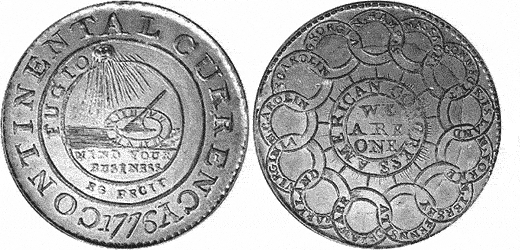
Okay, one more coin. This is the Continental Dollar; the very first coin of the brand new United States. It was designed — couldn’t you guess by looking at it? — by Ben Franklin.
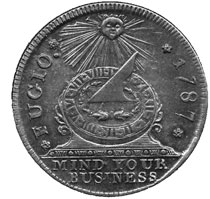
The motto “Fugio” (I fly) together with the sundial means “time’s a-wasting.” This motto also appeared on the penny at right some years later; it’s often called the “Fugio” penny. Check out the goofy little R. Crumb face on the suns.
It isn’t certain whether Ben meant “Mind Your Business” as in “you there! Look to your factories and your warehouses, Sir” or “sticketh not thy snout where it should’st not be.” With Franklin, it could go either way.
April 3, 2007 — 11:58 am
Comments: 19
Liberté – Egalité – Mustelidité
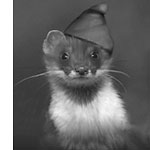 So, about Phrygian caps. Phrygia was an ancient kingdom in what is modern Turkey. It was conquered repeatedly by its neighbors, the ancients tell us, “for wearing those dumbass hats.” In Greek art, the Phrygian cap was used to indicate the wearer was some kind of foreigner, and Roman poets referred to Trojans as Phrygians. I claim extra credit for not making a cheap Trojan/hat joke.
 Anyhoo, the Phrygian cap was like a red nightcap with the point pulled forward. The next time it turns up in history, it’s being worn by freemen of Rome — former slaves whose freedom was so thorough, it would be passed to their children. And that’s where the hat became associated with freedom and liberty.
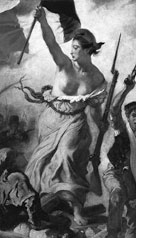
Like this lady, the tart with the titties (hoo boy! Googleanch, here I come!). The spirit of France is called Marianne, and she’s usually drawn wearing a Phrygian cap (or Bonnet Phrygien, eef you pleez). Here she is, flashin’ ’em for the troops.
Woohoo, Marianne! And Ginger, too!
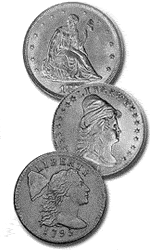 Phrygian caps were an essential symbol of the American Revolution, usually waved about on a stick, called a Liberty Pole. The Sons of Liberty in New York, before the Revolution, were professional Liberty Pole putter-uppers. They’d put ’em up, the Brits would tear ’em down. It was zany, madcap revolutionary fun. With occasional violence!
Hence, several early American coins pictured Liberty wearing the cap or waving it about on a stick. Unfortunately, our available pool of Revolutionary-era artists was not so hot, and the caps look hilariously like panties. Panties! On her head! Waved about on a stick! Allegorical Girls Gone Wild!
The cap still appears in the official seals of the US Army and the US Senate (which also features a bonus pair of crossed fasces). Plus the state flags of New York, New Jersey and West Virginia.
The panty craze swept Southward, with Phrygian caps appearing on the coins of Mexico and the flags or coats of arms of Cuba, Nicaragua, El Salvador, Colombia, Haiti, Argentina and Paraguay. ¡Caramba!
And then there’s the Smurfs. Really, I have no smurfing idea what that’s all about.
March 28, 2007 — 9:56 am
Comments: 12