










Writ in sand

That there is an image by a man named Benjamin Zobel (1762-1831), made entirely out of sand. To create this one, he dribbled sand from little paper funnels onto a sticky surface, which is why it survives. Most sand paintings — duh — didn’t survive the night.
In the 17th, 18th and 19th Centuries, European and British royalty employed artists as table deckers — before important feasts, these guys would be hired to make huge images out of sand and sugar and marble dust and whatever on top of the banqueting tables. Dishes of snacky foods would be laid on top. At the end of the night, it would all be swept away. Landscapes, religious pictures, portraits, hunting scenes, still lifes (yes, dammit, that is correct) — whatever was fashionable in painting was fashionable in sandpainting.
Which sounds at first like ghastly aristocratic extravagance, but I’m guessing these artists were paid considerably more than, say, the ones who make chalk pictures on pavement. Same difference.
I have a warm spot for ephemera. Making ephemera for a living teaches humility — not something you get a lot of in the art world. Nearly all the art I’ve made for money was intended to be used once, or a few times maybe, and then fade away. For most of it, that’s just as well.
Anyhow, table deckers and sandpainting — that’s what to Google if you want to know more.
February 16, 2010 — 7:21 pm
Comments: 10
…and the winner is…
And the winner of the Iowahawk Endowment for the Arts $33.18 Steel Cage Art Death Match is…
 Racist Pixel by US Citizen of Traction Control. Congratulations, dude — I know that’s the one *I* voted for.
But Iowahawk was kind enough to single out this ‘umble weasel (and John Manders — dammit, I wish I’d thought of a Big Daddy Roth hommage) for the Imaginary Certificate of Special Artistic Merit, which includes the Jack H. Squat Memorial Monetary Stipend.
Gosh, that’s the largest single paycheck I’ve gotten since November!
It was honor enough making the front page of one of my favorite writists. I was all, like, ZOMG! ZOMG!!!! SQUEEEEEEEE!
Wow. I had no idea I could make that noise.
October 12, 2009 — 6:25 pm
Comments: 17
Wot fink?

Iowahawk, of whom I am a huge fan-grrl, is having an art contest. At stake is a generous arts grant of thirty three dollar and eighteen cents.
These moneys, they am not good here. Our moneys are pretty color and they has a picture of a old lady in a sparkly hat.
Still…art contest. How can a weasel resist?
Okay, mine isn’t quite finished, but here’s the current draft. Yes, the full sized one is color. The contest doesn’t close until Sunday, so I have time to get this just right.
It’s imitative of the moving style of Gig and Keane and their richly evocative pity kitties. I suppose you could call it a Pity President.
In the first draft, he was licking his sore paw. But somehow, painting the presidential tongue was kind of. I don’t know. You know?
Wot fink?
September 28, 2009 — 6:28 pm
Comments: 41
Mad old bats in stereo

Uncle B’s mother is in the hizzouse. Okay for me; I get along with her just peachy, but I think the poor bastard feels like he’s in a mad old bat sandwich, and he’s the olive loaf.
Today, we all drove to the beautiful, haunted town of Winchelsea in East Sussex. Old Winchelsea was a large and important medieval town, until it was swept into the sea by a massive flood in 1287. Edward I ordered Winchelsea rebuilt on the hill above. A newfangled planned town, with the streets built on a grid.
The new Winchelsea was likewise a thriving port. But it was sacked by the French and the Spanish a few times and especially hard hit by the Black Death of 1348. When the harbor silted up in the 16th C, that was pretty much it. Winchelsea today is tiny and spooky and lovely and full of terribly, terribly rich people.
The surviving church — actually, the surviving chunk of the surviving church — is at the center of the grid, and it’s spectacular. For two months in 1855, John Everett Millais stood about where I’m standing inside and painted L’Enfant du Regiment, a wounded little girl asleep on the tomb of a knight (from a fictional story about an orphan adopted by her father’s regiment).
Well, he painted the tomb on this spot; he painted the little girl later in his studio. And a damn fine job he made of it, too. Millais is hit or miss — when he’s good, he’s very, very good and when he’s not, he isn’t so much. This one is very fine. It’s oil on paper laid on canvas mounted on board. It lives in Connecticut at the Yale Center for British Art.
And tomorrow? Dunno yet. Presumably, two old bats and Olive Loaf hit the road again…
August 25, 2009 — 6:55 pm
Comments: 2
There’s a plaice for us. Somewhere, a plaice for us.
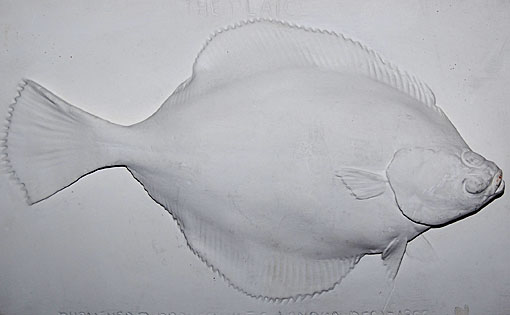
We went antiquing today and I bought was this attractive plaster cast of a fish.
One of my teachers in art school was the last of the old-time plaster casters, or so he told us. It’s a dying art. Incredibly important stuff, once. From the prosaic plastering-of-walls to medical casts of two-headed babies and bunions in the shape of George Washington. Those fabulous ornate ceilings, frames and gilt mirrors? Plaster — cast, carved and covered in gold leaf. Art students learned to draw from casts of great and famous sculptures and to sculpt from carving the stuff. Death masks, molds for ceramics, prototypes. Fresco. Gesso.
And don’t get me started on cement!
Anyhow, this is a modern cast of a Victorian cast from the British Museum. Presumably cast from an actual fish. It’s a plaice; a very tasty and popular flatfish. I’ve spent the whole day saying, “I’ve always wanted a plaice of my own” and “would you like to see my special plaice?” and “a woman’s plaice is in the kitchen.”
That’s twelve pounds worth of fun any day.
June 17, 2009 — 6:43 pm
Comments: 20
Impenetrable symbols

I’ve had to create graphics in international symbols style; I know boiling ideas down to a few simple shapes is not easy. Still, half the damn things are so utterly impenetrable, I feel sure it would be better just to spell it out in Maori or Sanskrit or whatever and let me look it up in the dictionary. (My favorite sign in the States was the international symbol for library. Pointless. What would someone who can’t read the local lingo need with a library?)
Britain seems more than ordinarily decorated with these things. Seems everywhere we go, some poor bubble-headed bastard is getting electrocuted, sliced in half like firewood and pan-fried. He should sue somebody.
Today, I ran across one so impenetrable, I’m still trying to work it out (see above). So far, this is my best guess:
■Holy shit!
■According to the book
■Rays of light will come shooting out of your face, your bellybutton and the tips of your toes
■If you stand too close to the monolith
Got a better idea? I can’t seem to find an international symbol dictionary, so I’m opening it up to suggestions. And no — I’m not going to tell you where I saw it. That would be cheating.
June 16, 2009 — 5:50 pm
Comments: 29
Your daily dose of artardation…
 Rainy day at last! See, this is the English climate I signed on for. I’ve got a fire and a booze and I’m kicked back browsing Her Maj’s art collection.
It’s pretty cool, actually. The royals have a thing for portrait miniatures, and the website has a cool dingus that lets you view the whole collection, zoom in and pan around each individual painting.
I have a thing about portrait miniatures, too. I painted a few back in the day and I’m thinking of taking it up again. It’s always been on Ye Bigge List of Things I Might Like To Do For Money When I Grow Up. It is a long and silly list.
The classic miniature portrait for hundreds of years was a watercolor, painstakingly built up of tiny flecks of paint on a piece of thin vellum glued to the back of a playing card (cards are about the right weight, is all). Later examples are occasionally watercolor on ivory or vitreous enamel or oil on copper.
Her Maj’s collection is mostly fine portraits of royalty (natch), but it was a much more ubiquitous art form, especially toward the end when all manner of spinsters, widows and maiden aunts got in on the act. Accessible to the commoner, in various levels of quality and portrait goofiness.
Photography finally killed off the art form in the 19th C, though it never died away completely. In fact, the Royal Society of Miniature Painters, Sculptors and Gravers wasn’t founded until 1896.
And tomorrow? Sunny and fine. AGAIN. Weasel will have to go out and play 🙁
May 27, 2009 — 7:08 pm
Comments: 15
ZOMG! Now I know where I am…!

We were driving around the countryside from garden center to garden center today, trying to find growing bags or strawberry plants or…some junk (I’m still unclear on the ‘gardening’ concept). One misty, flower-spangled leafy country lane after another. It was all very sparkly. Like the Ice-capades.
We drove through one tiny village and Uncle B said, “I think I counted six thatched rooves just then.” And then it dawned on me: I’m trapped in a Thomas Kinkade painting.
Y’all know this boo-boo, right? You should. He’s one of the most grinding self-promotional hustlers on the planet. Thomas Kinkade, Painter of Light ®. He sells framed bubble-jet prints by mail, in dedicated Thomas Kinkade Signature Gallery franchises and on the Home Shopping Channel for anything from hundreds to ten thousand dollars. For a print. To be fair, the really expensive ones are touched up with a bit of real oil paint by a registered detailologist. Or something.
I don’t hate Kinkade. His mixture of demonstrable technical competence, shit-awful taste, improbable Christian piety and rancid venality is…kind of…fascinating. Doing a Google images search this evening, I discovered he has moments of almost brilliance. And moments of such mindblowing gaudy crassness, it hurt like having my ass-bone broken and reset wrong.
I don’t know why the likes of Hallmark, Disney or the Salvation Army have anything to do with him. Well, I do — he claims to have pushed more than two billion-with-a-b dollars worth of merchandise. But he gives off a disastery vibe, if you ask me.
The FBI investigated him a few years ago for crippling his gallery franchisees with a combination of Jesus and strong-arm tactics. There have been allegations of heckling and groping and what Wikipedia called “his proclivity for ritual territory marking through urination, once relieving himself on a Winnie the Pooh figure at a Disney site while saying ‘This one’s for you, Walt’.”
See? How can you hate this guy?
May 13, 2009 — 7:29 pm
Comments: 20
Holy shit! Narcissist much?

Whoa! Check out Obama’s signature. I don’t know what a handwriting expert would make of it, but you can take it from a graphic artist (um, that would be me): this is a signature that has been practiced and practiced and fussed over and tinkered with until it’s just the way he wanted it.
This guy filled pages in his notebook with this during Homeroom. And probably Algebra class, too.
This is the John Edwards’ Poofy Bouffant of signatures. And I don’t think it’s an accident that the “O” and the “b” make a sort of Popey orb thing, do you?
Obama’s a lefty, too — I mean, he is left-handed — which makes this even more a labor of love. Lefties have to hover-write to avoid blotting their own copy.
And check out the pen. All the recent guys had their own personalized pens (which they give away after bill signings), but did the others include the president’s signature? I couldn’t find a picture of Dubya’s pen (it was a Cross), but I found Obama’s pen’s coming out photo shoot.

To be fair, it does look a bit like Bush signed his documents “GERBIL.”
April 29, 2009 — 5:39 pm
Comments: 44
Let’s talk asphaltum!

Art — if you care to approach it that way — is a subject rich in many robust varieties of geekery. History, chemistry, exotic materials. I really am going to start an art blog some day, but in the meantime I’ll just bore you guys.
Take asphaltum. AKA bitumen or pitch. I was thinking about it today (as you do). In intaglio, it’s used to protect metal plates from acid — the design is scraped away with a needle before etching.
Mixed with linseed oil, asphaltum makes a beautiful velvety brown paint. Like dark caramel. It neatly mimics the appearance of Old Master paintings that have mellowed with age.
Joshua Reynolds experimented with it. That’s his painting of Margaret Morris at left (please not to be making eye contact; Margaret obviously has the crazy eye).
The highlighted area shows the reason asphaltum is naughty. It’s not really a pigment at all (technically, a pigment is tiny solid particles of a colored substance), it’s just a sort of hydrocarbon goo. It never dries. It doesn’t even try. So paint laid on top of it becomes more brittle with age than the asphaltum underneath and inevitably cracks. Oil paintings often crack, of course, but asphaltum cracks have a dramatic, distinctive appearance called alligatoring.
Asphaltum is so lovely to look at and the effect usually takes so long to develop, some painters wouldn’t give it up even so. Long about the 18th Century, some bright colorist wondered if asphaltum that had aged for a very long time until it was apparently dry and brittle might not be safe to use. Paint made from very old asphaltum was sold as mummy or caput mortuum.
They stopped selling mummy in the 19th Century because a) it didn’t work — it alligatored just as badly as fresh asphaltum. And b) word got around it was actually made out of ground up Egyptian mummies embalmed in asphaltum! And it was, too.
April 16, 2009 — 6:44 pm
Comments: 24