












Giant hovering thing over Warwick turns out to be something not very interesting after all

This thing baffled people for days, after some girl captured vid of it on her phone (I like the picture that goes with. “Hi, I’m Georgina Heap and this is a phone.”).
Turns out they were firing pyrotechnics with a trebuchet at nearby Warwick Castle and accidentally blew a giant smoke ring.
Wait, hang on, that’s kind of interesting after all.
April 16, 2014 — 10:27 pm
Comments: 8
Such a bright looking lad

London barber posts pic of Kim Jong Un under the headline “Bad Hair Day?” gets visit from Nork embassy goons. Both sides reported to to police. Nothing will come of it.
I love the Kims. I mean, I don’t, obviously — they’re vile and horrible tyrants. But I love the way they confirm my theory that no checks and too much praise invariably turns humans into monsters.
April 15, 2014 — 9:44 pm
Comments: 12
Wait, what?

If I may continue my theme for another day, have a gander at this thing. It’s called the Mold Gold Cape (it was found in a place called Mold in Wales in 1833).
It’s an extraordinary thing. It’s sort of a shoulder cape hammered from a single piece of gold (the raw gold must have been about the size of a ping pong ball), then decorated all over with repoussé. They reckon it’s nearly 4,000 years old.
Four thousand years. That is a stunning level of craftsmanship for the time. Moreover, though there was mining in the area, there were no big cities nearby, no great dynasties that they know. Just this amazing thing buried on a hill in the middle of sweet fuck all.
It was dug up with a skeleton by workmen. This being 1833, they divvied up the gold (the cape was already broken in bits by time and earth) and scattered anything else they found. Fortunately, the British Museum got wind of it through a local and managed to buy back most of the pieces right away, though there are still a few fragments missing, and almost none of the other grave good survived.
I learned about this from a popular BBC Radio Series called a History of the World in 100 objects. It’s one hundred fifteen-minute podcasts about interesting and important objects in the British Museum, arranged in chronological order, chosen and narrated by the chief curator. I’m pretty sure if you hit the link, you guys are allowed to download and listen to this one. Great history in handy bite-sized chunks (if a little lefty in parts). Mucho recommendo.
The Mold Gold Cape is episode 19, and here’s how it starts:
For the local workmen, it must have seemed as if the old Welsh legends were true. They’d been sent to quarry stone in a field known as Bryn-yr-Ellyllon, which translates as the Fairies’ or the Goblins’ Hill. Sightings of a ghostly boy, clad in gold, a glittering apparition in the moonlight, had been reported frequently enough for travellers to avoid the hill after dark. As the workmen dug into a large mound, they uncovered a stone-lined grave. In it were hundreds of amber beads, several bronze fragments, and the remains of a skeleton. And wrapped around the skeleton was a mysterious crushed object – a large and finely decorated broken sheet of pure gold.
The fuck, BBC? We’re just going to walk on by that, really? See, this is where Brits can be entirely too blasé.
Three possibilities. One – it isn’t true; there weren’t any such sightings (but it’s hard to get a more rigorous source than the British Effing Museum). Two – hells yes, a ghost haunted this treasure for forty centuries (I’m not of a mystical bent, but what the hell – humility is the essence of science). Three – distant memories of a grand and famous burial persisted in local legend for four thousand years.
Holy cats.
April 2, 2014 — 10:09 pm
Comments: 7
Anybody missing a cleaning lady?
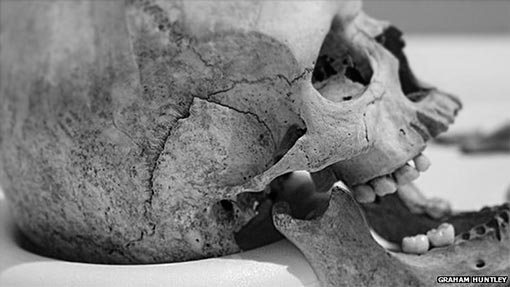
As we discussed below, they are ALlllways digging up stuff here. Every time they enlarge a parking lot or put an extension on an elementary school, they find some lot of poor skeletons huddling underneath.
Know what happens to them? Unless there’s treasure buried with them, not much. They’re catalogued, packed away in boxes and stored by the county council, more or less unexamined. There’s all kinds of stuff they can learn from DNA analysis and tooth enamel these days, but that shit costs money. And, as I said, there are so many, many old bones lying around.
We watched a program recently that went back and looked at some pretty ordinary Stone Age bones stored away in a warehouse somewhere. They discovered little holes drilled in many of them, post mortem. From the position, they deduced the holes were used to articulate the skeletons. Thing is, they weren’t awfully fussy that the right man’s leg bone was connected to the right man’s hip bone.
So, think on that. They were — I guess — digging up the ancestors, stringing skeletons together from random bits and — I dunno — hanging them up at parties? Does that blow your mind? That blows my mind.
Every once in a while, a local council gets a lottery grant to do some actual archeology, which recently happened in Eastbourne. They had 300 skeletons kicking around in storage, from 1,500 to 4,000 years old and they got £72,000 to do some science on them.
They dated and sexed them all (my goodness, that doesn’t sound nice) and singled out 12 for particular analysis. That lady in the header was the real surprise. She lived her whole life in Sussex and was buried in Roman times, about 245 AD, but she’s from sub-Saharan Africa. The Roman empire didn’t extend that far. What’n the heck was she doing here?
She was healthy, lived to about 30 and grew up on a plentiful diet of fish and vegetables. Wife, mistress, slave. They have no idea.
I guess I just thought we knew a whole lot more about early Britain — or, at least, had done everything we could to find out. Turns out, not.
April 1, 2014 — 10:08 pm
Comments: 5
Look, the old tenants left some stuff behind

This place has had so many previous owners, and they left so much of their junk behind. Europe, I mean. It’s tough for an American to take.
F’rinstance. In 1962, five Viking ships were dug up in the Danish town of Skuldelev, so they built a museum to hold them in the nearby city of Roskilde. In 1997, they went to enlarge the museum and accidentally dug up nine more Viking ships in the parking lot.
I know, right?
Anyway, one of them was the longest Viking ship ever found. It’s about a hundred feet long, and there’s maybe twenty percent of it left. Curators boxed the thing in flat-packs, like Ikea furniture, and shipped the whole business over here for a big show about Vikings in the British Museum.
They put a £135M extension on the place to house this (and displays like it). We saw it on TV the other night; it’s way cool. The whole end of the building opens so they can drive big objects right in.
On display with the ship is the Vale of York hoard, a collection of Viking silver found by father and son metal detectorists in a field in Yorkshire in 2007.
There’s a lot of that going on these days, too. Amateur metal detectoring leading to big finds, I mean. And for once, the government got wise and works with detectorists through the Portable Antiquities Scheme. Most detectorists know to stop everything when they make a good find and call in the experts.
By law, individuals have to report precious metal finds to a government officer. But here’s the smart part: if any museums want the artifacts, they have to offer the finder a fair market value. So looting is, like, nonexistent. It’s like having a giant voluntary army of archeologists combing the countryside.
If you’re at all interested in this stuff (and you probably wouldn’t be here if you weren’t), any of the links above will take you to hours of thrilling geekery.
March 31, 2014 — 9:15 pm
Comments: 16
In otter news tonight

These two adorable behbehs became orphlings when construction workers scared off their mom. They’re in care and doing fine a long way from here; I just wanted to run the picture.
Had coffee with the neighbors this morning. We’ve been told there’s an otter in the neighborhood.
We know there’s a mink in the ditch by the church. Mink are serious pests here. They’re not native and they’re madly aggressive. They’re all over the countryside because hippies released them from fur farms, and they’re endangering many local species. (Honestly, the ecological disasters we can trace to people who claim to care most about the environment…).
But, no. Mink apparently undulate up and down when they swim. This thing was about three times bigger and undulated side to side. So. Not the usual thing.
One of my neighbors lost two young chickens she had nursed through the Winter (they were born late in the season last year). A great big dog fox tore off the side of her shed and got at ’em. It was a new shed, too.
The people on the corner had to have their dog put down. It got out one night and was worrying sheep (a serious offense here) and when his master went to collect him, he went for his master. Dude had to fend it off with a flashlight. At this point in the story, somebody says shar pei, and everyone else nods sagely. I wouldn’t know a shar pei from a Sharpie.
And I asked a sheep farmer about Jack leading the ewe parade, and he said he wasn’t a bit surprised. Sheep are very curious, he said, and will check out anything unfamiliar in their enclosure.
And that’s it for the Farm Report this evening…
March 19, 2014 — 11:01 pm
Comments: 18
Weasels in the mist

I haven’t talked about the weather for a while, because I know a lot of you are still socked in with Winter and…well…no beating about the bush, we’ve had a sunny few days here. When it’s nice in England, it’s first-lovely-warm-day-in-Spring nice. It can be 72, sunny with a cool breeze for months on end, when we get lucky.
But we paid for it today. When the sea is cold and the sun is hot, we can get a weather phenomenon southerners call a sea fog or sea fret. Northerners call it a haar — or har, hare, harl, harr or hoar. It’s where we get the term hoar frost (the fog that freezes and sticks to things).
A sea fret is awesome to watch, because it’s dramatic and sudden. It’s a dense fog with a highly perceptible edge. It comes galloping in from the Channel, drops temps twenty degrees and reduces visibility to sweet fuck-all.
We drove into the one today. Clear one minute, whooff the next. Not the densest fog I’ve ever been in (that would be a cloud I drove into on Grandfather Mountain once), but it was pretty spooky.
I gather most of England got this one.
March 13, 2014 — 10:50 pm
Comments: 8
If you can just hold out a *little* longer

We took a long drive up the coast today. It was a good day for it; sunny and mild. Daffodils everywhere. AND WE SAW THE FIRST LAMBS OF THE SEASON. SQUEEE!
Spring is definitely coming. Just don’t lose your grip.
March 7, 2014 — 12:11 am
Comments: 19
An explosion was heard in rural Sussex over the weekend

Been on a bean streak lately. You know, dried beans, soak ’em overnight, cook ’em with fatback. It’s probably a variety of homesickness; I come from a bean eating people.
When I went away to college, I had to call my mother and ask her, “when we have a bowl of beans…what exactly kind of beans are those?” At the time, my ignorance embarrassed me, but turns out it’s not such a dumb question. There are many varieties of small white bean, and recipes play fast and loose with the definitions.
The one I was looking for was probably the navy bean, which is called that because we stuffed American sailors full of them in the late 19th, early 20th. And I know that’s true, because I’ve just reached the point in Norman Rockwell’s autobiography where he joins the navy, and he describes desperately painting portraits if the officers to ingratiate himself and escape the endless beans in the regular mess. Poor bastards.
Those beans are called haricot beans here and they are the base bean for Heinz baked beans. Yup, hard to believe those vile neon orange fuckers are made out of the innocent white navy bean, but it’s true.
One of our local markets put a bunch of beans on the reduced rack — the more exotic varieties just weren’t selling, I guess — so I have some new and wonderful beans to try. I’m especially looking forward to adzuki beans, which are little read beans used in desserts in the East.
Why I thought you might like to spend the weekend here talking about beans, I couldn’t say, but allow me to recommend the Bean Institute‘s quarterly newsletter if the conversation runs dry. Good weekend, beaners!
February 28, 2014 — 10:45 pm
Comments: 45
*sulk*

A tree fell on me today. It wasn’t a very big tree, and I was whaling away on it with a hammer and a masonry chisel at the time, so it had justification. Still. When a tree falls on one, one feels one has the right to sulk.
So I’m sulking.
And drinking.
February 25, 2014 — 11:34 pm
Comments: 20